Strength
Reading glasses strength: the one-minute test that picks your diopter
The test
Open any article on your phone at normal text size. Bring it to the distance you would naturally hold a book, about 14 to 16 inches, and slowly push it away until the text is comfortably sharp. The distance where it sharpens is your number:
| Text sharpens at | Start with |
|---|---|
| 16 to 20 inches | +1.0 |
| 20 to 24 inches | +1.5 |
| 24 inches to most of an arm | +2.0 |
| Only at full arm, or not at all | +2.5 |
Between two numbers, take the lower for screens and the higher for print. Readers magnify a zone, and the stronger the diopter, the closer and narrower that zone sits.
Age is a shortcut, not an answer
The usual drift: +1.0 to +1.5 in the mid-forties, +1.5 to +2.0 around fifty, +2.0 to +2.5 by the late fifties. Useful for a gift, but the phone test beats the birthday every time, because arms and reading habits differ more than lenses do.
When a catalog is the wrong tool
Two cases skip the value packs and go to an optometrist: eyes that want different strengths, and blur at distance as well as close up. Off-the-shelf readers put the same diopter in both lenses and correct nothing else. Headaches that persist after two weeks of the right-looking strength are also worth a professional look.
Why the packs make sense
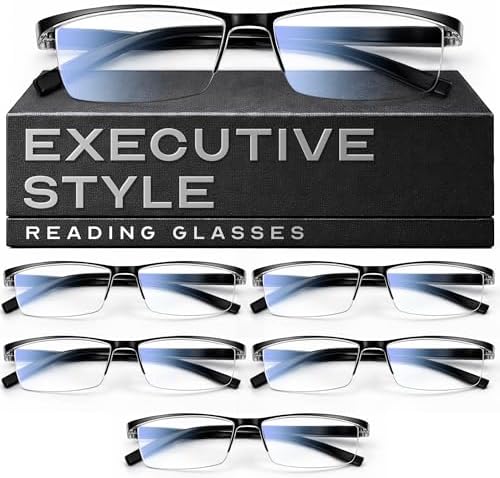
Readers come off fifty times a day, and every removal is a chance to leave them somewhere. The 4, 5 and 6-packs put the same strength in every room at $2 to $4.40 a pair, so the nightstand, the desk and the car each keep their own. Every Gaoye reader also carries the blue light coating, which earns its keep if your fine print lives on a screen. Spring hinges take the daily folding; the care guide covers the rest of the lifespan.